Cloud Data Engineering
No sections found
In today's digital ecosystem, every company generates a huge amount of data wether it's user activity, transactions, logs, or data from external sources. But raw data is not very useful in its original form. It can be messy, incomplete, and scattered across different systems.
To make smart business decisions, companies need data that is clean, organized, and easy to analyze.
This is where ETL pipeline come in.
ETL pipeline help business take raw data, clean and organize it, and store in a way that can be used for reporting, dashboards, and analytics.
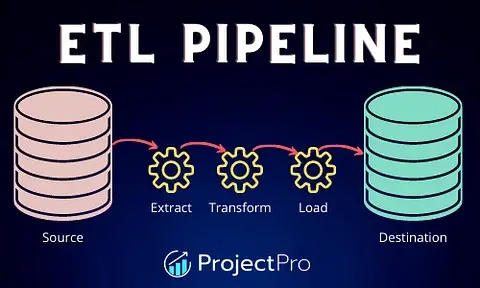
ETL stands for:
In simple words, ETL is a process that turns messy data into useful information.
In this step, data is collected from different places like:
Problem here:
Data comes in different formats and large volumes, so handling it properly is important
Tools commonly used for extraction include tools like Fivetran and Stitch, which automatically pull data from applications and databases. For handling large-scale data transfers, tools like Apache Sqoop are also used.
This is the most important step.
Here we:
After this step, data becomes clean and reliable.
For transforming data, companies often use powerful tools like Apache Spark for large datasets and dbt for SQL-based transformations in data warehouses.
Now the cleaned data is stored in systems like:
There are two ways to load data:
Data loading is handled using tools like Apache NiFi and Airbyte, which help move processed data into data warehouses or storage systems.
Let's take an e-commerce company:
Now the company can:
A simple ETL system includes:
| ETL | ELT |
| Data is cleaned before storing | Data is stored first, then cleaned |
| Works well in traditional systems | Used in modern cloud systems |
| Slower for big data | Faster with modern tools |
Some widely used ETL tools in the industry include:
These tools help automate and simplify the ETL process.
ETL pipeline help companies:
Even though ETL is powerful, it has some challenges:
ETL pipelines are an essential part of modern data systems. They help convert raw, messy data into meaningful insights that businesses can use to grow and improve.
We build high-performance web applications, mobile apps, and AI-driven systems. Let's discuss how we can help you achieve measurable growth.