Data Engineering
No sections found
In today's data-driven world, applications generate millions of records every second. However, slow SQL queries can become a major bottleneck, affecting performance, scalability, and user experience.
In this blog, we'll explore real-world SQL optimization techniques that actually work - covering indexing, execution plans, join order, and performance tuning strategies used in production systems.
SQL optimization is the process of improving the performance of SQL queries so they run faster, use fewer resources, and scale efficiently with large datasets.
SQL optimization means:
Without optimization:
With optimization:
When SQL queries are slow:
Optimizing SQL is not optional - it's essential for building scalable systems.
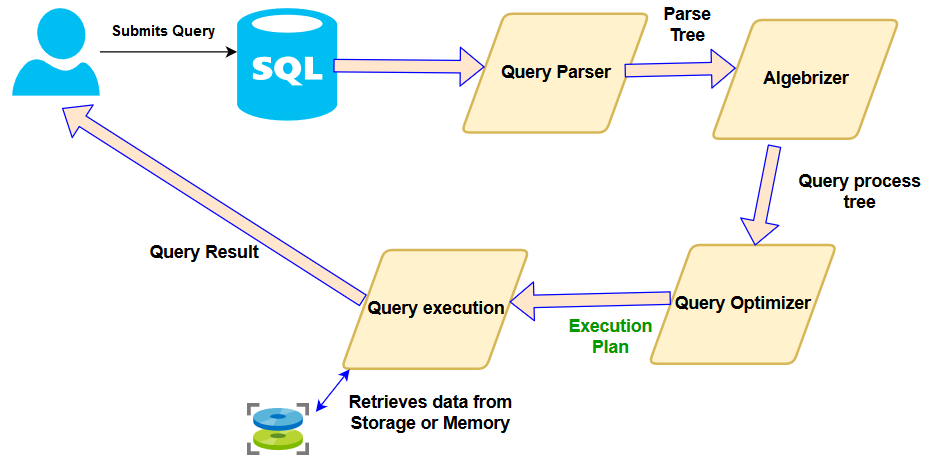
When a SQL query is executed, the database processes it through a series of well-defined steps. Each step plays a crucial role in determining how efficiently the query runs.
Parsing
The database first checks the query for correct syntax and structure. It ensures that table names, columns, and SQL keywords are valid. If there is any error, the query is rejected at this stage.
Algebrizer
The Algebrizer is the component of the SQL query processor that converts a parsed SQL statement into a logical relational algebra tree by resolving object names, semantics, checking permissions, and determining data types.
Optimization
After parsing, the query optimizer analyzes different ways to execute the query and selects the most efficient execution plan. It considers factors like indexes, data size, and join methods.
Execution
The execution engine runs the query based on the chosen plan. It accesses data either through indexes (faster) or full table scans (slower), depending on the optimization.
Processing
During execution, the database performs operations such as filtering rows (WHERE), joining tables (JOIN), and aggregating data (GROUP BY, COUNT, etc.)
Result Delivery
Finally, the processed data is returned to the user or application in the required format.
The execution plan generated during optimization is the most important factor affecting query performance.
Full Table Scan (Slow)
Index Scan (Fast)
Smart Indexing
Indexes improve query speed by reducing data scanning.
Ex:- 
Best use cases:
Considerations:
Avoid Unnecessary Data Fetching
Ex:- 
Reducing selected columns:
Efficient JOIN Operations
Ex:- 
Optimization Rules:
Early Data Filtering
Ex:- 
Early filtering reduces processing overhead.
Limit Result Sets
Ex:- 
Useful for:
Execution Plan Analysis
Ex:- 
Provides:
Sequential scans on large tables often indicate optimization opportunities.
Replace Subqueries with JOINs
Ex:- 
JOINs are generally more efficient and scalable.
Appropriate Data Types
Correct data types improve performance:
Composite Indexing
Ex:- 
Effective for multi-column filtering.
Table Partitioning
Large tables are divided into smaller segments (partitions).
Benefits:
Query Refactoring
Efficient queries reduce execution cost.
Database Maintenance
Regular maintenance ensures optimal performance:
Caching Strategies
Caching frequently accessed queries reduces database load.
Common tools:
Denormalization (Controlled Use)
In read-heavy systems, combining tables can:
Trade-off: Increased redundancy.
| Scenario | Before Optimization | After Optimization |
| Query Time | 8 seconds | 0.5 seconds |
| Scan Type | Full table scan | Index scan |
| Improvement | - | 16x faster |
Changes Applied:
When working with multiple tables, most developers assume that SQL executes joins in the same order as written. However, modern databases like PostgreSQL or SQL Server reorder joins automatically to find the most efficient execution plan, this is called Join order optimization.
Join order :- Join order is the sequence in which tables are combined during query execution, decided by the optimizer to minimize cost and data processing.
Joining large tables too early can create huge intermediate datasets, slowing down performance.
How optimizer decides Join order:
In real-world systems with millions of records, join order can make the difference between a query running in milliseconds vs minutes.
SQL performance optimization is a combination of understanding internal execution, applying structured techniques, and continuously monitoring performance.
Small improvements in query design can produce significant gains in:
Efficient SQL is a foundational skill in modern data systems and remains critical as data volumes continue to grow.
We build high-performance web applications, mobile apps, and AI-driven systems. Let's discuss how we can help you achieve measurable growth.